


Daniel King, Research Fellow at the Foundation for American Innovation and Laura Hiscott, Staff Writer for AI Frontiers — October 8, 2026
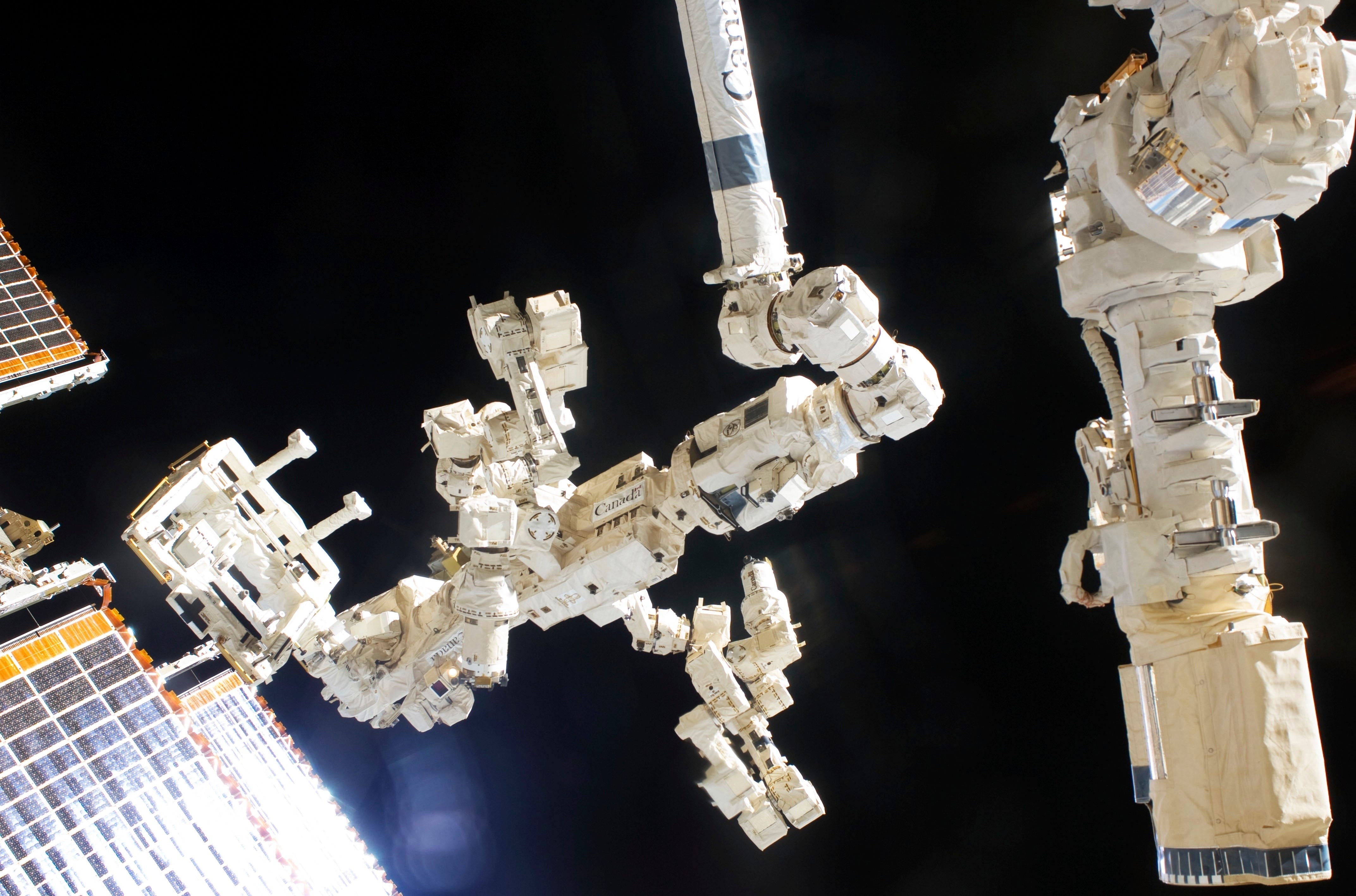
The opening moves to industrialize space will look like a string of ordinary business decisions. Consider a space-services company that begins assembling solar arrays in orbit. It supplies power to its customers but also to itself. To keep installations running, it sends along robots that inspect, assemble, and replace modules or faulty components. The company deploys more of these machines as its customer base grows, and soon, it is producing enough specialized robots to run orbital shipyards and small off-Earth factories. Each of these activities on its own serves an intelligible commercial need, but together, they form the foundations of a general industrial economy beyond Earth.
Space agencies and private companies have entertained this vision of the future for decades, but it has remained technologically out of reach. Now, artificial intelligence may be poised to advance space timelines dramatically through automation. The spoils of the AI race therefore extend far beyond digital supremacy in which one country has the best hackers or the most productive knowledge workers. Powered by an industrial flywheel in space, in which existing infrastructure compounds and allows the construction of yet more infrastructure, whatever actor first manages to combine proficiency in AI with launch capacity and robotics could achieve enduring supremacy in space. Other states, looking on from the sidelines, may scramble to catch up—or find by then that it is simply too late.
In this essay, we explain how AI promises to accelerate the industrialization of space and outline the advantages that a first mover might expect. We then look at the dynamics between an incumbent space power and aspiring newcomers, including a winner-take-all outcome, and the prospect of a point of no return once a leading actor expands into deep space.
Automating the Space Frontier
Space is an environment where AI will enable the development of industry almost from scratch. Autonomous systems will pilot vehicles and tend power stations—they already do so on Earth. Deeper in space, robots may prospect for resources, such as minerals, and prepare these sites for the arrival of development convoys. Such a future has remained the stuff of science fiction because useful machinery in space faces extreme conditions and—more critically—requires supervision by human operators. Artificial intelligence addresses both of these challenges.
AI will enable spacecraft to operate autonomously. Consider the latency currently presented by remote control: a radio signal takes roughly 20 minutes to travel between Earth and Mars when they are farthest apart in their orbits—an excruciating 40 minutes for a single call-and-response. As a result, a mission can be doomed by a mistake or unforeseen event while mission control sits powerless to intervene. Soon, advances in AI will enable spacecraft to understand their surroundings, and robotic automation will enable them to manipulate those surroundings, letting them adapt in real time to events that today would mean mission failure. Future spacecraft will also benefit from the orbital equivalents of shipyards and refueling stations, enabling maintenance, repairs, and cargo handoffs that widen the menu of possible actions for vehicles serving a variety of missions.
AI will make spacecraft more resilient. AI-driven advances in domains such as materials science and robotics could produce space vessels that are more resilient to the conditions of space and more sophisticated in the range of actions they can conduct. Additionally, many vessels that today would need to support human astronauts could instead be guided by AI systems, greatly simplifying their design. A future fleet could dispense with the habitable volume and life-support machinery (such as pressurized compartments, crew passageways, and supplies of food and water) that make crewed spacecraft so bulky and fragile. A speck of space debris that could puncture the International Space Station (ISS) with fatal consequences might leave an equivalent but uncrewed, unpressurized vessel largely functional. Even if that spacecraft is destroyed, it can be replaced cheaply and without loss of human life.
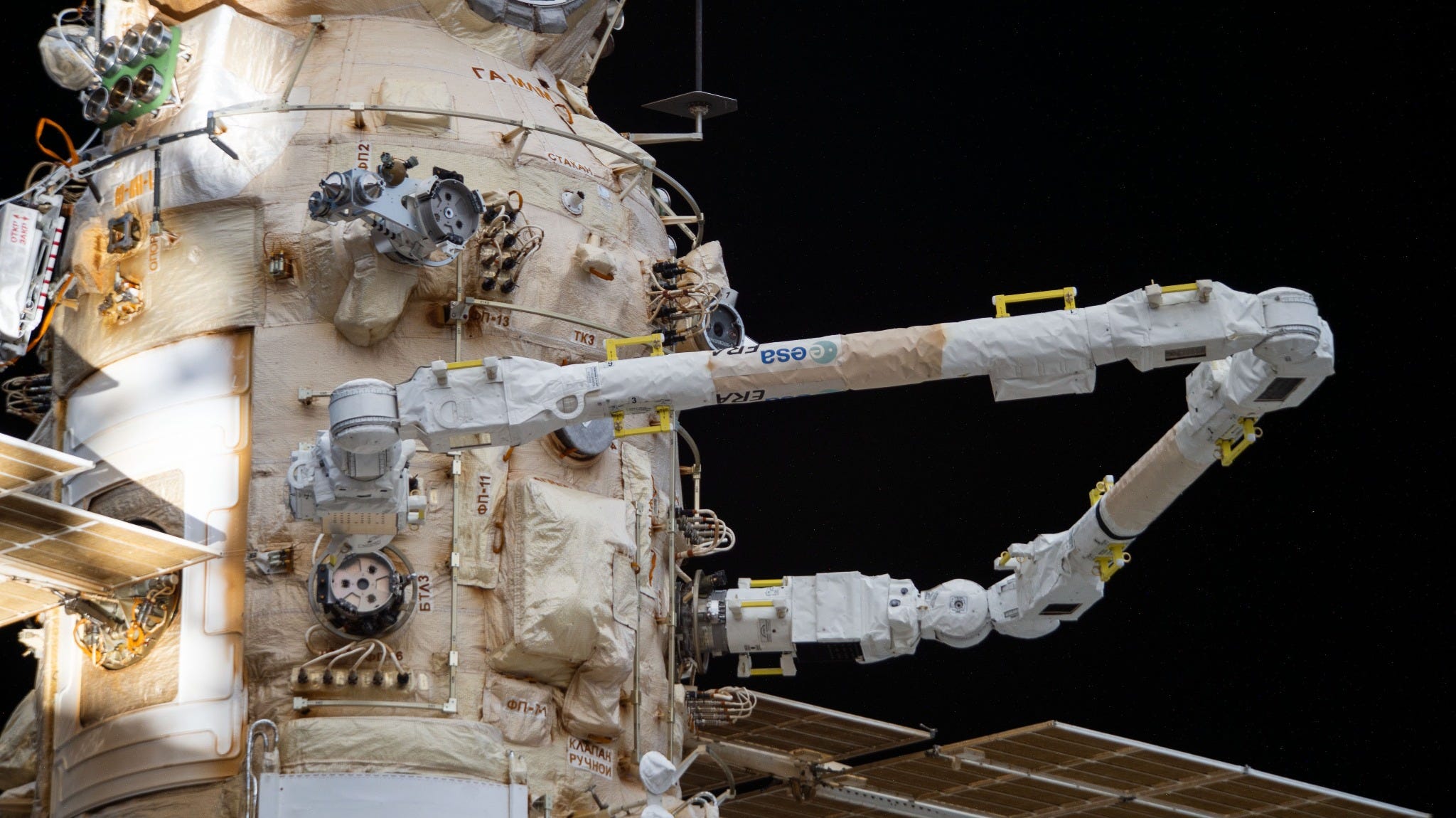
Automated assembly in space is the first glimpse of industrialization. The companies—or single company—that automate space industrialization will likely do so in stages. The first will consist merely of using specialized robots to service or assemble components delivered from Earth, as is current practice. In May 2026, ground controllers used Canadarm2—the International Space Station’s crane-like robotic arm—to pull NASA’s CLARREO Pathfinder instrument from a separate cargo spacecraft and mount it on the ISS itself. The European Space Agency’s European Robotic Arm has gone further, moving large components between station modules and helping install a radiator and airlock. This modular approach enables the assembly of structures too large to fit inside a single launch vehicle.
Ultimately, industrialization will involve automated manufacturing from scratch in space. In the future, orbital workshops equipped with general-purpose tooling will facilitate in situ manufacturing: the in-space manufacture of products that would otherwise have needed to be launched from Earth. This is especially valuable for emergency components that cannot wait for a fix to ship from the ground. Currently, extraterrestrial in situ manufacturing is the subject of active experimentation: in 2024, a European Space Agency experiment aboard the International Space Station used a laser to 3D-print a small metal test part from stainless-steel wire, building it up layer by layer.
Sourcing raw materials is another challenge that has seen progress. There are straightforward concepts for taking advantage of relatively abundant feedstock in space, such as lunar regolith (i.e., moon dust), as a building material. For instance, since 2021, Blue Origin’s Blue Alchemist program has been fabricating solar cells from simulated lunar soil—purifying silicon for the glass and photovoltaic components while fashioning wire out of naturally occurring aluminum oxides.
These demonstrations are the baby steps toward bustling orbital factories, but the challenges that remain are concrete engineering problems.
First-Mover Advantages
Getting to space first matters. A pioneering actor in space learns the idiosyncrasies of operating in and building for that environment, riding down a steep cost curve and experience curve. By the time a delayed second mover arrives, the first mover may have figured out how to do all of this reliably and cheaply, at scale. Indeed, the pioneer will have received a top-tier education in this unforgiving environment. It will also have ready access to existing infrastructure in orbit to support its further ambitions, including orbital shipyards that can assemble structures too large to fit inside a single launch fairing. This could enable capabilities qualitatively beyond those of laggards, who would be building from scratch.
A hefty industrial flywheel could open a large gap between leader and follower. Recursive self-improvement is a phenomenon that appears far beyond AI model development; it applies to physical processes too. That includes the tech stack in space. An advanced space actor will benefit from strong positive feedback loops. Consider recursive returns to the energy supply. The availability of energy is a hard constraint—a necessary but not sufficient condition—on the rate at which sustained industry begets yet more industry. On Earth, even the best solar installations are compromised by night, clouds, and atmospheric losses. On the other hand, the same kind of panel placed in a dawn-dusk sun-synchronous orbit could collect three to five times as much energy—without interruption. And that energy will power intelligence, robotic automation, and the construction of yet more solar arrays.
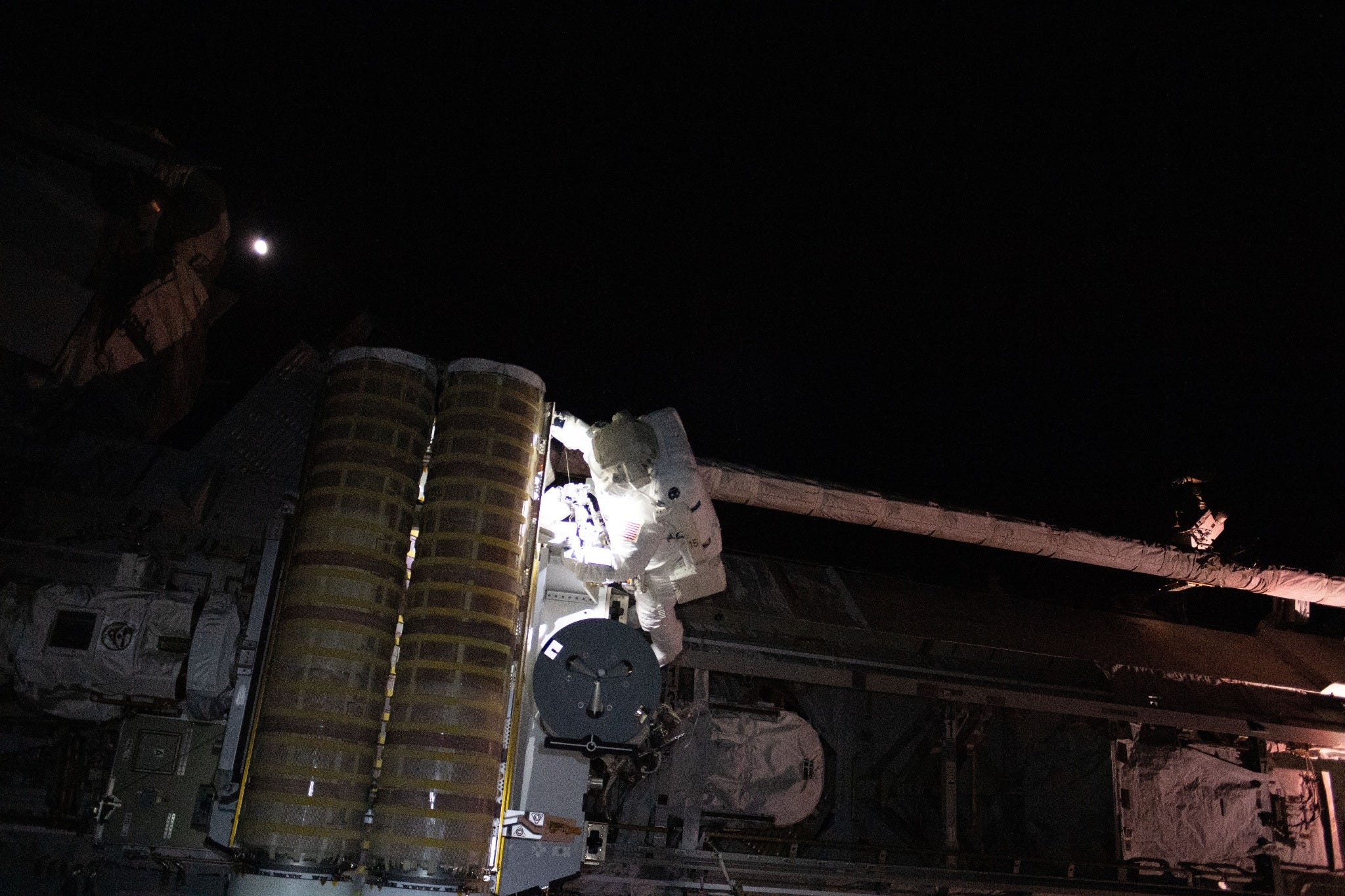
This is one triad of general-purpose technologies that will strongly self-reinforce as well as mutually reinforce. Each is an input to the other two: intelligence improves robots and energy collection; robots build more compute and energy infrastructure; and energy powers intelligence and robotics. In full bloom, the outer-space economy will look like recursive self-improvement of the physical by the physical, mediated significantly by the cognitive.
First movers could occupy the most advantageous sites. The prizes of space are also unevenly distributed in terms of location. Near the lunar south pole, some of the most coveted operating sites combine nearly uninterrupted sunlight and a line of sight to Earth with a rare source of frozen water, preserved in the shadow of craters. The Outer Space Treaty forbids states from claiming sovereign title to lunar territory, but it also requires states to conduct their activities with due regard for others and to avoid harmful interference. In this vein, the Artemis Accords provide for temporary “safety zones” around active operations. First movers may therefore exploit some of the blurred benefits of territorial control without ever receiving legal title to a plot.
An AI front-runner could build a large military and economic lead. The current immaturity of the space stack means that we are far from any of the hard ceilings on growth, and an AI-driven industrialization of space may take off rapidly. In a direct military conflict, a standoff between spacecraft of a leading actor and those of a challenger might be quite comical. As Avi Parrack put it, that could look “like a coracle taking on an aircraft carrier.” Short of military conflict, in an economic contest, this leading actor would also have the better products and services at its disposal, including control over critical capabilities on which later entrants are dependent.
There may be bottlenecks that limit how much a leading actor pulls ahead. Of course, on Earth as in space, production is limited by complex factors. Energy alone is not sufficient. Neither is intelligence. If the jagged frontier persists, meaning that AI capabilities remain uneven across realistic tasks, superintelligence may not provide a sufficient condition for state supremacy. Even after attaining Top-Expert-Dominating AI, an actor may find that victory in the subsequent AI-industrial takeoff instead remains a messy problem: full of fits and starts and requiring deliberate, carefully judged decision-making over scientific and industrial policy. There will be bottlenecks on this industrial flywheel—much as there are limiting inputs in the Earthly economy—such as the speed at which manufacturing and physical supply chains adapt. One country’s physical intelligence may lag behind its capabilities in canonical cognitive tasks. Thus, even for a state actor that unambiguously leads in AI, a post-superintelligence physical economy cannot be assumed to outcompete all others hands-free.
Does Winner Take All?
It is unclear whether the first mover will secure permanent control of space as a domain, or whether trailing actors can still enter later and reap many of the rewards, even if their share is smaller. There are two possible mechanisms through which being first to industrialize space might also grant exclusivity: runaway compounding advantages, and denial of access to new entrants.
Compounding advantages could enable runaway industrialization that followers never catch. As described earlier, space will feature an industrial flywheel in which early competence allows a first mover to establish space infrastructure, which it can then use to obtain more energy and material for yet more infrastructure. In other words, the larger the leader’s presence in space, the more quickly that presence keeps growing. Such an exponential trajectory could simply run away from rivals trying to catch up; the incumbent might gain control of most resources near Earth while other powers are still trying to get a foothold.
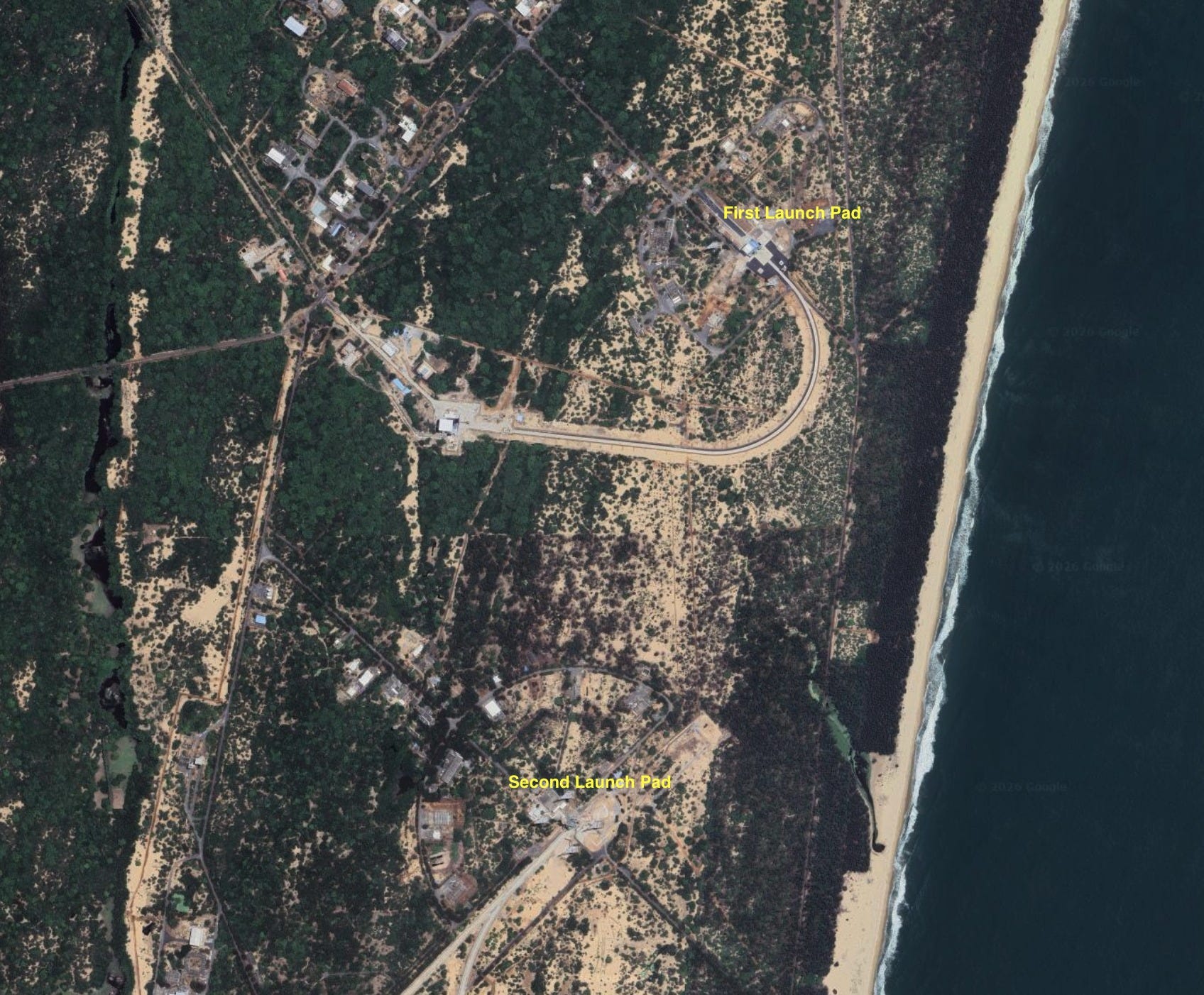
With better Space Domain Awareness, an incumbent could deny access to newcomers. Alternatively, if the first mover hits bottlenecks to growth, it might instead achieve exclusivity by blocking would-be entrants from entering or sustaining orbit. A leader would have significant Space Domain Awareness, an understanding of the objects and opportunities in its environment, including the ability to track enemy assets. This superior awareness would facilitate incumbent efforts to sabotage newly arrived assets. Exclusion can be achieved on the ground as well, where nation-states’ major launch sites are often geographically concentrated. India’s two primary launch pads, for example, are both located at the Satish Dhawan Space Centre. If facilities remain clustered in a handful of conspicuous sites, they will be ripe for obstruction or disruption by a leading actor.
However, the front-runner might still struggle to seal off space to newcomers entirely. While an incumbent observing from above Earth’s gravity well would have a strong information and infrastructure advantage, this might not translate into an ability to block rivals from getting into space. There is a strong international norm against physically striking other nations’ soil unprovoked, so a leading actor is unlikely to destroy rivals’ launch sites outright. It may instead try to intercept space vessels or deorbit them once they have left their sovereign territory.
Alternatively, an established space power may try to seal off access by distributing enough space debris to prevent ascending vessels from entering orbit. Indeed, there have been concerns that even accidental collisions between satellite fleets could trigger Kessler syndrome—a phenomenon in which one space collision generates debris that goes on to cause further collisions in a destructive chain reaction. However, analyses suggest that this risk has been overstated; space is enormous, and creating a sufficient density of debris to effectively block new launches—even intentionally—would require so much upmass that it may be practically infeasible.
The industrial flywheel is a front-runner’s best bet for winner-take-all. Given the challenges of keeping rivals out of space indefinitely, it seems more likely that a first mover will secure space exclusivity through the kind of self-reinforcing industrial explosion described earlier than through direct efforts to deny others access. And this type of industrial takeoff is precisely the path that will be most readily available to a leading actor that already possesses superiority in AI.
Self-Replicating Spacecraft
Once the race to control space matures, competitors might build self-replicating spacecraft that explore the outer reaches of the solar system and beyond. This possibility raises important questions about a monopoly over the cosmos in the long run.
A first mover may send out self-replicating robots to expand into deep space. An actor that pulls ahead of the pack during near-Earth space development will be poised to first launch von Neumann probes—self-replicating industrial systems that use extraterrestrial resources to propagate further copies of themselves through space. If these machines can spread too quickly for rivals to rein them in, or for their own self-replicating machines to catch up, these machines may secure greater control of deep space than all others.
Laggards could wait to build faster probes. Being the first to launch von Neumann machines might not guarantee durable hegemony, particularly if scientific and technological progress accelerates on Earth. Rather than trying to keep up with the first mover, a trailing actor might instead bide its time and try to develop more advanced von Neumann machines that can travel faster, use resources more efficiently, and ultimately overtake the earlier launch. Laggards might have ample time before rivals’ spacecraft ever reach other star systems, the closest of which lies several light-years away, since a ship traveling near the speed of light would face significant risk from collisions with interstellar dust.
Whether followers catch up may depend on the efficiency of intelligence itself. It is currently unclear how strongly intelligent discovery depends on scale, in terms of both the hardware on which it runs and the energy that it consumes. While scaling compute has brought tremendous advances in AI capabilities in recent years, there remains a view that intelligence can, in principle, be remarkably efficient. The human brain, for instance, takes up just 2% of the body’s mass and requires only 20 watts of power. If breakthroughs in deep learning produce highly efficient, advanced AI systems, a von Neumann probe may be able to carry a highly sophisticated intelligence that can conduct its own scientific research and keep improving itself—keeping up with progress on Earth—as it spreads across the universe.
On the other hand, there is some evidence that, no matter how intelligent AI systems become, scientific discovery will always require simulating or searching through a vast space of ideas—and that having a larger quantity of compute and energy for this kind of brute-force experimentation will always significantly accelerate progress. Moreover, a probe in deep space would receive communications from Earth only with significant delays, impeding its ability to access and build upon the rapid progress being made on Earth. Thus, an enormous supercomputer on Earth might outthink an AI housed in a von Neumann-style machine, powering faster technological improvements and giving trailing actors a greater chance of catching up.
The risk of sending out potentially misaligned self-replicating robots should give us pause. One needs no expertise in strategy to realize that dispatching a self-preserving machine—effectively a virus—into space is no light matter. The AI arms race today risks both concentration of power in the hands of a few and loss of control of misaligned AI agents. The race to release self-replicating robotic systems would pose these risks on a cosmic scale. If von Neumann probes are aligned to the hegemon, one actor’s vision becomes baked into the universe indefinitely. If instead the probes are misaligned altogether, loyal to no nation and driven by an objective of their own, releasing them becomes a dreadful, potentially irreversible mistake. Nations would have a common interest in pooling intelligence and industrial capacity to exterminate these probes, with no guarantee of success. In either case, trailing actors have an interest in preventing the hegemon from ever launching such probes, which could monopolize the future spoils of space. Even the leading actor should have sobering hesitations about ever launching such probes.
Military Escalation
It is unclear whether one actor can achieve a permanent victory in space. Nonetheless, in extreme cases, if a trailing nation is concerned about a winner-take-all outcome, it may resort to military action to remain in the race.
Today, sophisticated, expensive space capabilities are vulnerable to attack by cheap missiles. Trailing actors may feel reassured to contemplate that the military balance in space does not obviously favor the pioneer—today. At present, a close rival would be able to compromise the United States’ military capability in space because critical functions still depend on a small number of exquisite, fragile satellites, many of whose orbits are known to enemies. A direct-ascent anti-satellite missile, known as an ASAT, can reach low Earth orbit in a matter of minutes, and its target is a sluggish, low-thrust spacecraft with far inferior maneuverability; the asset in this scenario is all but doomed. And some sophisticated capabilities can take years to replace.
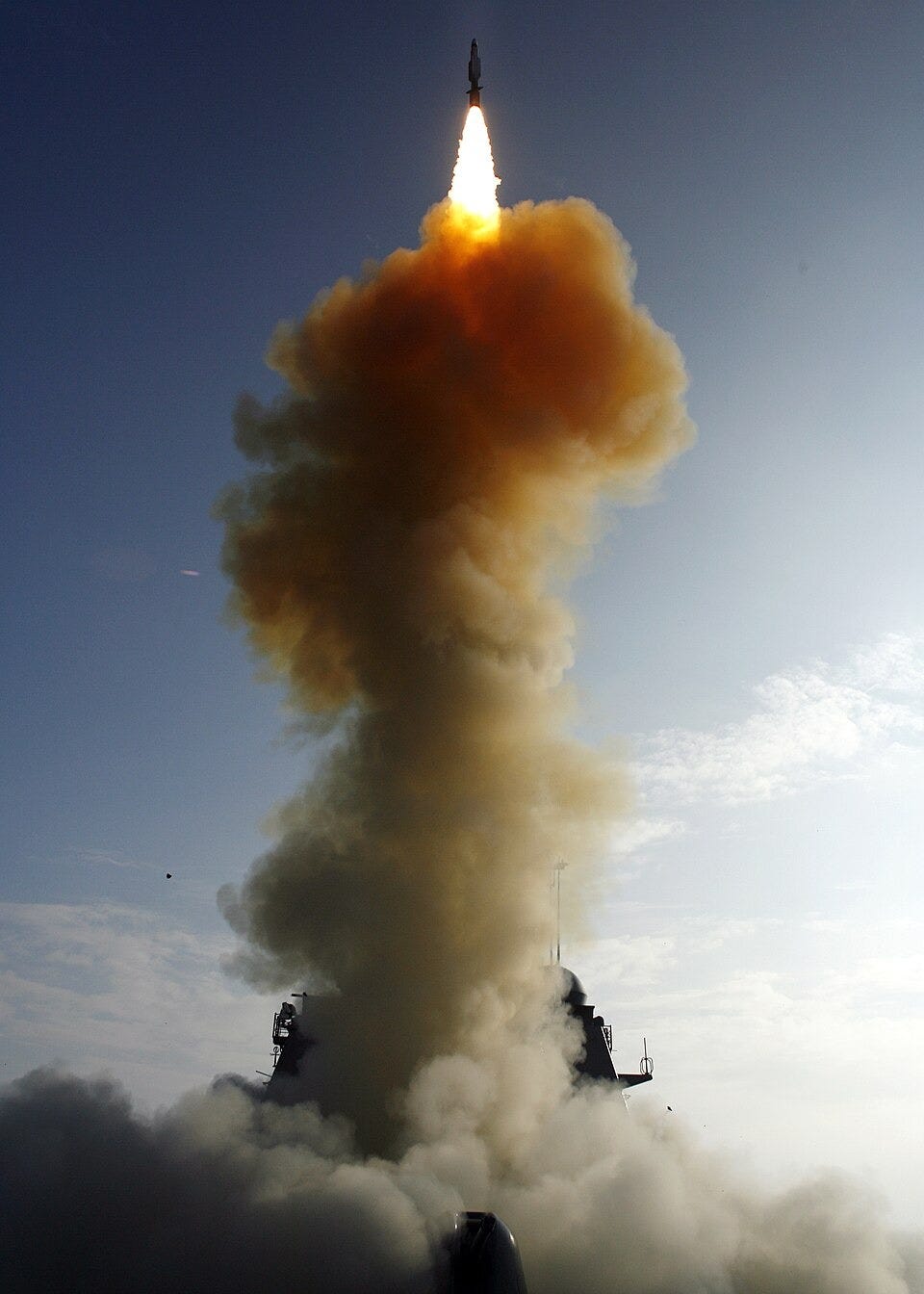

Add to that the cost exchange between attacker and defender. For example, telecommunications provider AST SpaceMobile estimates that each of its next-generation BlueBird satellites will cost roughly $21–23 million. Meanwhile, one recent estimate places Chinese ASATs at roughly $5–11 million apiece. Even for a leading power, mass-produced commercial spacecraft can therefore cost several times more than what an adversary needs to destroy them. For these reasons, the modern domain of space has been described as offense-favoring.
Unfortunately for rival states, this may not last. As the leading actor rapidly accumulates industry experience and economies of scale, there might be a phase shift that turns the asymmetry in favor of defense.
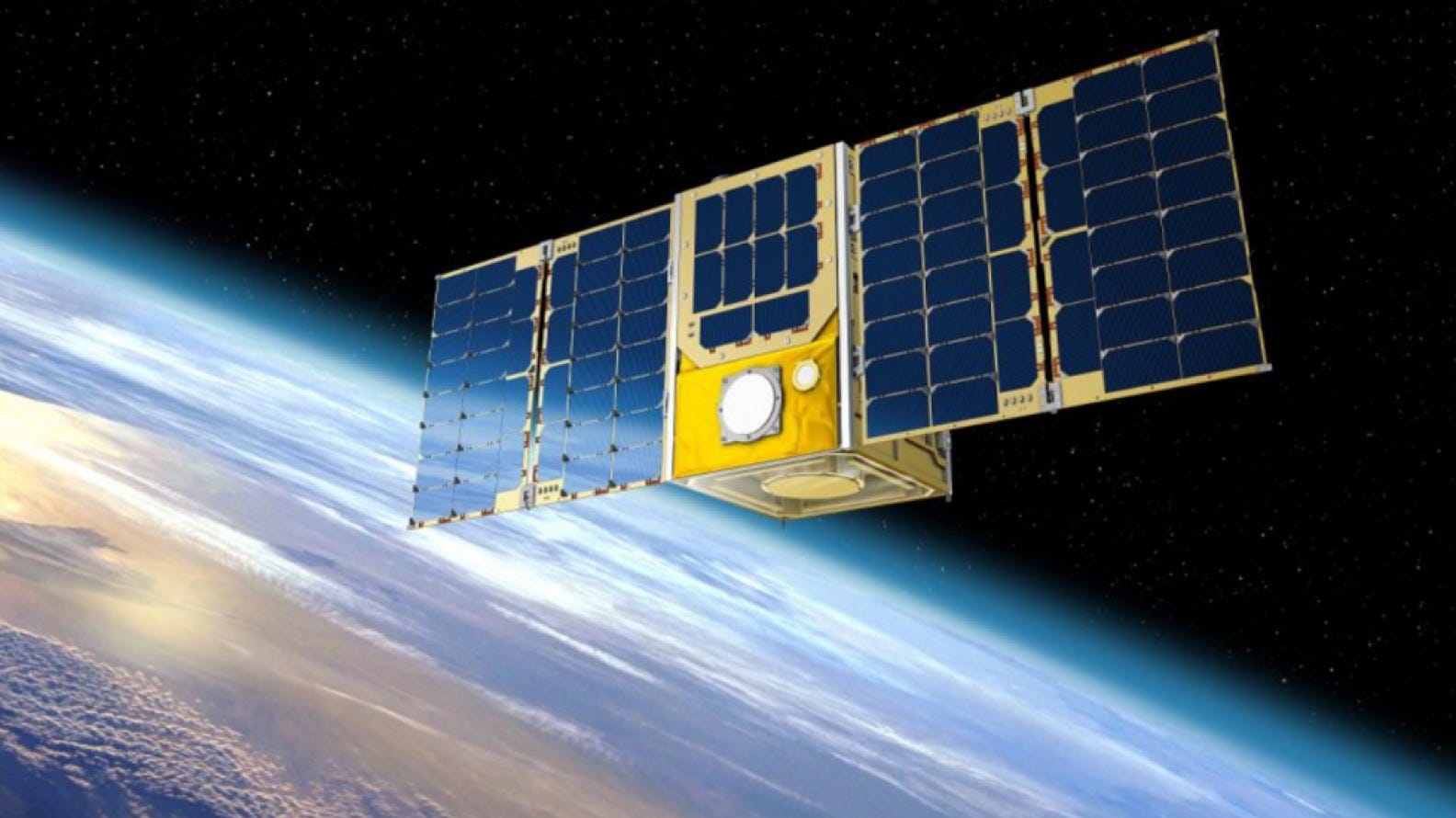
Space assets are dropping in cost and may become as inexpensive as attacks on them. Consider the future of orbital data centers. SpaceX’s first Starmind satellite is designed to house an Nvidia Vera Rubin NVL72 system, which is ordinarily quoted at roughly $5–8 million. SpaceX is already streamlining the external components of each spacecraft, and Starship—the company’s forthcoming line of super heavy-lift launch vehicles—is expected to reduce launch costs further yet. Thus, commercial efficiencies might eventually bring the cost of orbital infrastructure in line with that of interception.
A leading actor may become resilient to losing single assets without compromising the system. Besides equalizing the cost imbalance between offense and defense, each generation of cheap spacecraft also buys the front-runner more room to absorb losses and frustrate repeated attacks. The US Space Force is already moving in this direction. Its leaders describe a future “hybrid, self-healing architecture” in which capabilities once concentrated in a handful of exquisite satellites are spread across proliferated constellations that can lose individual nodes without dropping out of service. Furthermore, the US is making advances in rapid reconstitution. In its VICTUS NOX demonstration, the Space Force took a satellite from warehouse storage to operational orbit in roughly five days.
When facing an incumbent power, then, challengers may find that destroying spacecraft is not enough. Rival states will need pockets deep enough to sustain this attrition, and they will need to impose losses faster than a front-runner can replace or route around them; they will need to muster a sufficient sum and tempo of force. And in any confrontation there will also be a risk imbalance; while a mature space power may treat a loss as just another part of its ongoing maintenance costs, a new entrant’s smaller space program may find an equivalent loss far harder to recover from. For trailing states, outlasting a pioneering adversary of superior intelligence and industrial capacity seems an ever-dimmer possibility.
An incumbent space power would have active defenses on top of this passive resilience. Further compounding the difficulties for would-be new entrants, a mature space power would have many more advantages than simply being able to replenish individual satellites. A leading actor would likely also build up capacity to observe and detect new launches from Earth, allowing ample warning of incoming attacks. It may also develop the ability to neutralize such attacks, including through signal jamming, laser weapons, and resident escorts—smaller satellites that accompany and protect the primary asset. France’s investment in fleets of patrol and guard satellites demonstrates the beginnings of such defenses. Over the long term, using cheap spacecraft to keep more sophisticated capabilities in orbit will be a significant advantage to an incumbent.
Rivals may still find ways to take out the leader’s assets en masse. Most of the advantages described above derive from an incumbent’s amassing a large fleet of space assets, plus significant capacity to build more. However, scale does not erase all vulnerabilities. For instance, a challenger could target ground infrastructure involved in coordinating the leading actor’s space assets, as well as shared communications channels and software systems, to disable many assets at once. Another appealing possibility for a newcomer might be to trigger Kessler syndrome. Short of achieving this effect, strategically distributing localized debris could seriously impair an incumbent’s fleet. As a last and extremely escalatory resort, the radiation from a high-altitude nuclear detonation could catastrophically damage numerous assets at once. As an incumbent becomes largely immune to losing single assets here and there, rivals will be increasingly incentivized to discover broader weaknesses that can inflict more consequential damage.
Even as a winner-take-all outcome looms, military escalation will feel taboo. Despite the caveats outlined above, it remains a possibility that a first mover could lock in a decisive strategic advantage in space, or at least make it extraordinarily difficult for newcomers. Yet the stepwise development toward space industrialization means it is impossible to pinpoint the precise moment when the first mover moves. The same factories, depots, and defenses that amount to ordinary growth for the pioneer start to look like the pursuit of space hegemony from outside. For the best chance of preventing lock-in, the time to preempt this buildup is early, before the leading actor can widen the gap and entrench its advantages. But, unfortunately for rivals, this is also when preemptive attacks look like entirely inappropriate, paranoid assaults on commercial activities.
The Point of No Return
One day, we may see a news story about autonomous robots in space, possibly processing lunar regolith with excavating buckets. Videos from the company behind them might circulate on social media, showing one robot flipping onto its back so that another can perform repairs. Viewers may even find this cute.
It will dawn on some experts that they are witnessing the beginnings of resilience and subsequent dominance in space. But national-security discussions will struggle to entertain the idea of attacking these capabilities. It would look like wholly inappropriate aggression on another country’s commercial success. Unfortunately for trailing actors, there may thus be no window of time when an intervention is both early enough to prevent the worst outcome and sufficiently proven out to appear legitimate. We do not experience technological revolutions—nor geopolitical shifts—in neatly announced phases divided by clear thresholds. The point of no return may pass unnoticed.
Space is not a brand-new domain, but AI may be about to drastically accelerate its industrialization, demanding make-or-break decisions of leaders under ever-greater urgency and uncertainty. States will need to navigate the coming years with care, or risk waking up one day to find their future a fait accompli. The stakes are—literally—astronomical.
See things differently? AI Frontiers welcomes expert insights, thoughtful critiques, and fresh perspectives. Send us your pitch.
Daniel King is a Research Fellow at the Foundation for American Innovation, where he focuses on physical infrastructure for artificial intelligence. He has published and testified on data center buildout, electric grid reform, and behind-the-meter generation. Previously, Daniel worked for a power generation startup. He holds an MA in statistics and data science from Yale and a BS in mechanical engineering and applied mathematics from Brown University.
Laura Hiscott is a staff writer for AI Frontiers. She has worked in science communication for over six years, both in press offices and at magazines. She studied physics at Imperial College London and trained in science communication at the European Southern Observatory.
We will most certainly move the AI race off planet. Absent some world changing calamity the physics makes it a virtual certainty. The misaligned robot risk is also a virtual certainty unless we solve alignment first.
That requires us solving us first. There is the problem. We want the machine to be better than us and we can't even agree there is a thing there.
Off planet installations will be serviced by embodied AI, aka robots. Energy is abundant. Embodiment means real recursive learning from one's environment without human oversight (human foreman's really?)
Does no one else see a problem here?