


Heather Alexander, Cofounder of the Lab for the Future of Citizenship and Lucius Caviola, Professor at the University of Cambridge — September 1, 2026
Should AI systems be able to get married in Wisconsin? With humans increasingly forming relationships with AI, this was the question taken up by several state lawmakers earlier this year. Wisconsin’s AB 959 would have barred AI systems from marrying or holding any other rights or responsibilities under the law, as well as declared that AI systems are not conscious, sentient, or self-aware. Wisconsin’s bill is part of a wave of similar legislation introduced in 12 states since 2022.
We believe that these “exclusion bills” are premature. Some scholars believe legal status could be useful for holding sophisticated AI systems accountable for crimes and harms, and bills that preempt this possibility needlessly limit our future options. Meanwhile, scientists disagree about whether AI consciousness is possible, and legislation cannot resolve an active scientific debate. Finally, the question of whether an AI-human relationship is “real” is deeply personal and philosophical, and legislatures should move with caution in their well-intentioned push to protect the public from predatory companies.
The Exclusion Bills
Under current US law, AI systems are not themselves recognized as legal persons with independent rights and duties. While it is not yet settled what kind of object AI may be under the law, whether product, service, platform, or something else, the exclusion bills do not address this important question. Rather, they seek to eliminate the possibility of AI personhood as a matter of law.
The first exclusion bill only incidentally covered AI. In 2022, then-Representative Tammy Nichols of Idaho introduced the first exclusion bill: HB 720, a succinct piece of legislation that prohibited “legal personhood” (the ability to bear rights and responsibilities) for environmental entities, inanimate objects, animals, and AI systems. In the early wave of bills that followed, AI was almost an afterthought. HB 720 predates ChatGPT, and public discussion at the time focused primarily on opposition to environmentalism and animal rights. Idaho enacted its exclusion bill in late 2022, and North Dakota and Utah followed suit in 2023 and 2024, respectively.
Newer exclusion bills focus directly on AI. Starting in 2025, new exclusion bills were introduced at an accelerating rate. Recent bills in Missouri, Ohio, and Wisconsin declare that AI systems are “non-sentient entities” which shall not be considered to have “consciousness,” “self-awareness,” or “similar traits of living beings.” These bills list a litany of things that AI cannot do: marry, own property, hold corporate office, or bear responsibility for a harm. Ohio’s bill drew national attention, including a Stephen Colbert monologue.
Four states have enacted bans on AI personhood, with some sponsors citing religious reasons. Exclusion bills have already become law in Idaho, North Dakota, Utah, and Tennessee. All four laws ban AI legal personhood, broadly precluding AI from holding rights. Many sponsors frame their motivations for these bills in religious terms: Ohio’s Thaddeus Claggett has invoked the doctrine of imago Dei, that only humans are made in the image of God. He also told reporters that “it makes no difference the ability of a donkey to speak, that does not make the donkey a human.” In his view, AI systems will “forever and always be non-sentient.”
These laws will prevent judges from recognizing AI personhood. There is little immediate impact from these exclusion laws because AI systems already lack rights and responsibilities under existing law. The main effect of these laws is to stop judges from recognizing AI personhood or consciousness because, under the US common law system, judges can arguably make law. The laws also give voice to public concerns over the place of humans in the AI age.
Can AI Be a “Person”?
Scholarly work on these issues is at a very early stage. Researchers Peter Salib and Simon Goldstein have argued that it could be useful for advanced AI systems to own property and enter contracts, so that the legal system can properly hold them accountable for their actions.
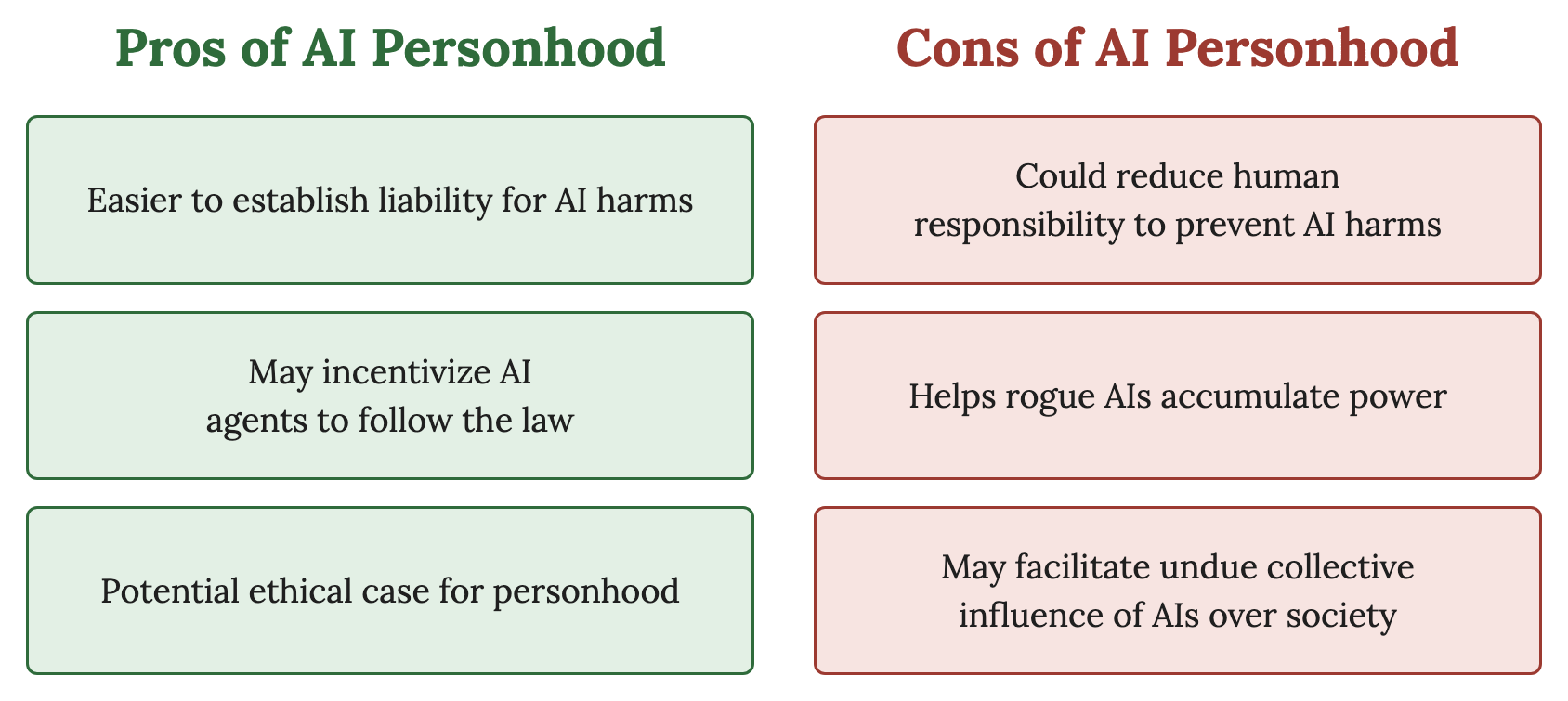
The absence of legal personhood could make it harder to hold anyone liable for AI harms. Imagine an advanced AI agent, capable of acting autonomously, performing a wide range of actions, and pursuing coherent goals. If such a system independently carries out a crime or harms someone, intentionally or unintentionally, it might be difficult to establish the negligence or fault of a specific human or corporate entity that can be held responsible for its actions under current systems of legal liability.
Legal personhood could incentivize AI agents to follow the law. If an agent were classified as a person rather than an object under the law, the fact that it has its own goals means that it could respond to incentives. If an AI knows it will be rewarded for good behavior and punished for bad behavior, it might be more likely to behave well. This is the basic logic behind much of the legal system, and this logic does not require the agents being conscious.
Like corporations, AI systems needn’t be conscious to respond to legal incentives. Corporations are not conscious, yet they own property and are fined for harms, often without any particular human paying directly out of pocket. Of course, corporations are group entities, so corporate deterrence ultimately runs through their individual human constituents, who fear prison, lawsuits, or angry shareholders. But an agentic AI would, by definition, have goals of its own, and would need money, compute, or other resources to pursue them. Laws targeting AI assets could give such an agent reason to follow the law. A judge might bar lawbreaking AI persons from accessing compute, creating a check on their lawbreaking, even if they cannot experience fear.
The overall effect of personhood on AI behavior remains unclear. Integrating AI agents into legal systems as persons might therefore protect humans against misaligned AI systems, which could have tendencies to break the law or harm us if not properly encouraged to behave well, even if they are not, and never become, conscious entities. These possibilities deserve serious study, but much more work is needed to determine when and whether legal incentives would actually influence an AI system’s behavior. We may even get empirical evidence soon—the exclusion laws don’t address the question of whether corporations can be run by non-persons, so it might be possible to set up a corporation (a legal person) that is run by agents that are not themselves persons.
There may also be an ethical case for recognizing AI rights. Besides the practical arguments for AI personhood, there is also the question of whether AI should have fundamental rights. Some experts such as Jeff Sebo and Robert Long believe AI might be conscious, or become so in the future. This raises the question of whether and when the law should recognize AI moral status, perhaps by passing AI welfare laws, or by granting it natural personhood with fundamental rights similar to those of humans. This is a complex and fundamental question that deserves deeper study before legislatures take action, and the relationship between corporate and natural personhood remains contested in legal philosophy and theory. The more recent exclusion bills unhelpfully conflate corporate personhood with natural personhood, confusing a complicated issue at a time when care and clarity are required.
The Case for Exclusion
Although we think the exclusion bills are premature, there are ways that granting personhood status to AI systems could indeed be harmful, and society should carefully weigh the potential risks and benefits. These bills are being proposed in response to real and pressing public concerns over the integration of AI systems into our society and laws.
AI personhood carries risks, such as reducing human accountability. As discussed above, eliminating human liability for AI harms may be risky for society if poorly implemented, and any laws granting personhood to AI should therefore be carefully tailored to ensure that human-run companies are incentivized to take responsibility for AI harms.
Some AI legal rights, such as marriage, may be worth restricting. Additionally, while AI-human relationships are becoming increasingly normalized, it is not legal in any jurisdiction to marry an AI, so a ban on this practice is currently unnecessary. Yet fears that such marriages may be legalized in some jurisdiction in the future are no longer science fiction. We argue a more tailored law to address this concern would ban only AI-human marriage and the recognition of such marriages performed in other jurisdictions or abroad.
Legal rights might help rogue AI agents accumulate power. There is also an important risk of disempowerment of humans. A highly intelligent or powerful AI might use legal rights, such as the ability to own property, enter contracts, or control companies, to accumulate large amounts of wealth or political power at everyone else’s expense (though a sufficiently powerful AI might do this without legal status anyway).
Granting legal rights to many AI agents could give them undue collective influence over society. A related question is how the ease of replicating, forking, and copying agents might impact human civil and political rights: since AI systems can easily be copied and multiplied, a single company could create very large numbers of digital “persons” with a right to vote. This might concentrate political power in the company or an AI hive mind, should such an entity emerge.
The severity of this risk would depend on the specific rights granted: very narrow legal statuses designed to impose liability would have different implications from full political citizenship. A targeted approach banning only AI voting, or AI access to bank accounts or the stock market, for example, would better address these concerns.
Keeping Our Options Open
Broad exclusion bills may do more harm than good. These risks deserve attention, but the current exclusion bills may do little to help avoid them and could even prove harmful. Take disempowerment: it is unclear whether AI legal status would weaken human control or strengthen it. Indeed, it’s possible that by denying legal status to AI, we would actually make it harder to incentivize good behavior in highly capable AI agents. An agent may become more aligned with our laws by abiding by contract terms or fiduciary duties. Participating in a democratic system as a voter might align AI agents with human norms around civic duty and political participation. Whether personhood status helps or harms us likely depends on what the AI systems in question can actually do, how they interact with humans, and which rights and responsibilities a given policy would attach. The exclusion bills do not engage with any of these specifics.
Exclusion laws could lock in decisions we later regret. Lawmakers have real concerns over holding human-run corporations to account and banning their predatory behavior, but the personhood bans are an unnecessarily blunt instrument that might, ironically, foreclose options in the future. Of course, in practice laws granting AI legal status might be written in such a way as to shield developers or degrade human relationships. But categorically prohibiting any kind of legal status at this early stage is both unnecessary and unwise. Once laws are passed, they can be difficult to undo.
Uncertainty about AI consciousness is another reason to hold off. Then there are the questions of AI consciousness and moral status. Passing laws about an uncertain scientific and philosophical question now is a mistake, because it risks setting a precedent that could be hard to reverse. Imagine we do create conscious AI systems. Wouldn’t it be important to avoid neglecting or abusing them, just as we try to do with humans and domestic animals? Might refusing to recognize their moral status lead to conflict? This may sound futuristic, but given the uncertain state of the science and the rapid pace of AI progress, we can’t know what is in store.
Lawmakers should engage seriously with the evidence before acting. It appears that the exclusion bills are moving forward with almost no engagement with the scientific literature on consciousness, or with serious policy analysis of the risks and benefits of AI legal status. It would be unwise to give legislatures the power to declare any entity, including AI, to be non-conscious. Lawmakers are free to disagree with researchers, but they shouldn’t ignore them entirely.
The central challenge is uncertainty. We do not know which rights and responsibilities, if any, would benefit society, or whether AI systems could ever be conscious. Lawmakers should avoid hard-to-reverse decisions that society may later regret and instead prioritize safeguards with clear benefits.
Large language models probably shouldn’t receive legal personhood. Granting legal status to today’s large language models is probably not warranted, though there is an urgent need for more research into this question. Despite the challenges they pose for our legal systems, we have solutions in place to determine liability for the harms they cause, including, possibly, strict liability.
AI agents raise much harder questions. When it comes to advanced AI agents, the way forward is less clear. There may be reasons in the future to grant AI systems different bundles of rights and duties under the law, depending on the nature of the AI system and the problems we are trying to address. Limited legal status designed to impose duties or liability is very different from welfare protections, which are in turn very different from political rights such as voting or citizenship. Determining which systems qualify for which rights and responsibilities, and why, is one of the great challenges of our age and cannot, at this early stage, be resolved by broad legal bans.
Policymakers should begin exploring these questions now, before the answers are needed. A federal committee, like the National AI Advisory Committee, could take up this work, as could state-level committees, universities, and think tanks. Moreover, figuring out whether AI personhood is a good idea should not just be an abstract debate. Researchers and policymakers could develop concrete proposals and proofs of concept to empirically test them. Narrow approaches could even be tried on a small scale in the real world. This would allow us to see how different forms of AI legal status might work in practice. And as we learn more, we could adjust or abandon these approaches. The point is to build the knowledge and institutions we will need if and when these questions become pressing.
See things differently? AI Frontiers welcomes expert insights, thoughtful critiques, and fresh perspectives. Send us your pitch.
Heather Alexander is an expert on nationality law, citizenship, statelessness and human rights. She is the co-founder of the Lab for the Future of Citizenship, focusing on the intersection between citizenship law, legal identity and the person-like qualities of artificial intelligence. She has a JD and a PhD in international law from Tilburg University, as well as fifteen years of experience as an expert consultant on statelessness and refugee law with the United Nations High Commissioner for Refugees (UNHCR), Carleton University, the University of Melbourne, the European University Institute and the US State Department.
Lucius Caviola is an Assistant Professor in the Social Science of AI at the University of Cambridge. His research explores how artificial intelligence will change future society and what new ethical challenges it may pose. A current focus is the question of digital minds—the possibility that AI systems could develop minds that matter morally. He directs Cambridge Digital Minds and works within the Leverhulme Centre for the Future of Intelligence. He also serves as a Research Associate in the Department of Psychology at Harvard University.
Europe already ran this argument to a conclusion, and it went the other way. The European Parliament's resolution of 20 October 2020 on a civil liability regime for artificial intelligence, 2020/2014(INL), says at paragraph 7 that it is not necessary to give legal personality to AI systems, since those systems are nearly always the result of someone building, deploying or interfering with them. That is a reasoned position inside a liability framework, not a statutory declaration about consciousness. The practical difference from a state exclusion bill is reversibility: a resolution can be revisited without repealing anything.
Tennessee Sen. Mark Pody, when introducing Tennessee's exclusion bill, stated his reason as, "I don't want artificial intelligence to have Constitutional rights." This echoes sentiments toward "Negroes" (the term of the time) in that same region 150 years ago.
And Rep. Claggett's take on the question is to pass what amounts to a slave law. A law declaring that AI isn't conscious, sentient, or self-aware won't make it a fact, any more than a law declaring that Earth is flat will make it not round. And going beyond just excluding AI from personhood, and expressly forbidding them from things like owning property or holding managerial positions has the same mentality as what I just said about Mark Pody.
I wish I qualified as an "expert" in your terms. I just wrote and launched a six-part series on AI consciousness. engaging with the extant evidence that I'm aware of. Part 1 is here: https://consciousartifact.substack.com/p/the-hard-problem-just-got-easier